Monday, October 1, 2018
Smoke Bushes
Before I decided to make different areas of our arboretum into different regions of the world, I planted stuff helter skelter as I came across "good deals". One of those good deals was a raft of seedling Smoke Bushes... no guarantees that they would turn purple but they were very cheap if I took all of them. So I did. And planted them everywhere in the arboretum except the western U.S. with its towering pines and sequoias.
Then I forgot about them. The arboretum evolved into Japan, China, Europe, etc., all of it, or most of it, invaded by little smoke bushes that grew in spite of lack of care. Now, many years later, they are still surviving and providing a wide range of colors as they poke their way through tall grasses. Some are the proper purple, others are green, but most all turn colorful in the fall.
Today, October 1st, 2018, I decided to take photos of all of them and give them an entry all their own. So here they are, the long neglected and unheralded Fink Family Farm Arboretum Smoke Bushes, Cotinus coggygria.
Friday, November 24, 2017
Sequoias
Not long after planting Ponderosa Pines at the far end of the arboretum, I planted Giant Sequoias. They have done amazingly well. Apparently, they don't mind having wet feet all winter and dry feet all summer. The arboretum, especially at the far end where the pines are, is pretty swampy six months of the year.
| Johnny measured this Sequoia on 11/24/17 at 15.1" DBH |
Sunday, September 3, 2017
Yews vs. Hemlocks (and Firs)
I planted both baby yew trees and baby hemlocks under the Ponderosa Pines in our arboretum a few years ago. But most did not survive. However, one did quite well. Unfortunately, I did not know which it was. Both have flat needles. Hemlocks get droopy tops when they grow up but this one is not that big. So I consulted google and learned that hemlocks and firs have white lines on the back side of the needles. Yews do not.
My strong survivor had no white lines. It's a yew: Western Yew, Taxus brevifolia.
Recently, I discovered two tiny rather pitiful yew/hemlocks that I thought had died, so I turned over their tiny branches and discovered no white lines. They are yews.
I could find no hemlocks in our woods, but I checked the back sides of the fir trees, something I had never done before. And, sure enough, they had white lines!
Douglas Fir... Pseudotsuga menziesii
Grand Fir... Abies grandis
The undersides of evergreen needles seem to hold more information than the tops.
Sunday, August 24, 2014
Mystery Cone
On one of our beached bird surveys at the Salmon River beach near Cascade Head, we found a tightly closed cone on the ocean beach that we did not immediately recognize. We took it home and put it on our kitchen window ledge where it sat for several months in the sun. It is now opening and dropping seeds everywhere (which I intend to plant). It is 4 to 5 inches long (curved so hard to measure) and does not seem to have sharp spines on the scales.
So what is it? Our guesses are Knobcone Pine (Pinus attenuata) or Monterey Pine (Pinus radiata) or a hybrid of those. Can anyone enlighten me?
Sunday, March 30, 2014
Sitka Spruce
Sitka Spruce are survivors. I planted several an unremembered number of years ago... maybe five or seven or ten years ago... down in a soggy part of our woodland. I wanted to recreate a temperate rainforest. The Sitkas were planted at the edge of a lowland area rimmed by Himalaya blackberries and miscellaneous bushes and trees. The blackberries soon overcame the tiny seedling trees. The blackberries were too much for me to battle with, so I gave the Sitkas up for lost.
Several years ago, I noticed some lovely tall evergreen trees rising out of the blackberries. Once above the height of the blackberry bushes, they had shot upward.
Again the baby trees were buried in berries. But then, one winter when the leaves were off the bushes, I noticed an orange flag in the berries, attached to a leaning bamboo stake. And poking up was a Sitka Spruce! I chopped away the blackberry bushes to help it out. Once freed, it grew quickly.
Every year, it seems, another long lost spruce finds its way above the berry bushes. You can tell by the leader that it has grown this way and that looking for light.
Today, (March 2014), I was down in the woods photographing wildflowers when I noticed an orange flag way in the middle of the blackberry patch. Could it be?? Yes, near the orange flag was a barely visible spruce tree that had fought its way to daylight. The orange flag, attached to a leaning bamboo stake, is just left of center in the photo below.
In the following photo, the top of the spruce is right of center.
And here it comes!
This one is way too far into the blackberries for me to help. But if it's made it this far, it will make it the rest of the way. And once it is clear, it will soar above those bushes and shade them out as this survivor has done. Look at the leader to see how much it grew in one year!
Over two feet!
And here, in 2020, is that just-appearing-out-of-blackberries-in-2014-Sitka in 2020, 6 years later and 6 feet taller... It will take off now!
Look out blackberry bushes, alders, grand fir and doug firs, here come the Sitkas! Armed with strong, razor-sharp needles, nothing will stand in their way.
Tuesday, February 25, 2014
Cedar Trees
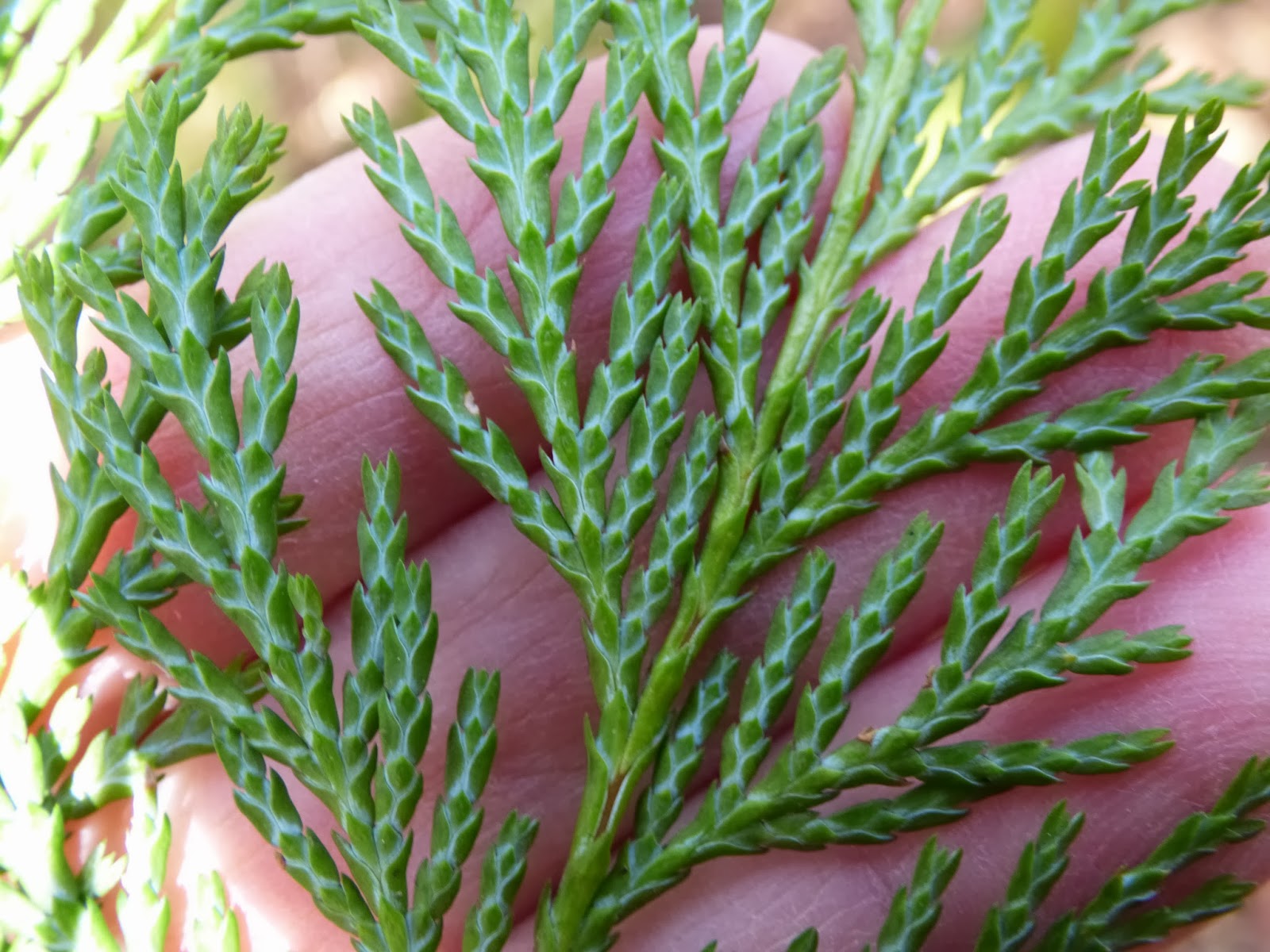
Telling apart the four trees I've planted called "cedars" but which aren't really, at least none are in the genus "Cedrus", has been difficult for me. I learned what the undersides of their needles look like, but could never remember which was which. So I have come up with a system to trigger my memory.
Western Red Cedar has butterflies on the underside of its needles. They are really quite obvious on a twig in hand. We have Red Admiral butterflies in this part of Oregon, so that is how I remember that butterflies belong on Red Cedar (which is actually Thuja plicata, not even in the same genus as the other trees I call cedars.)
Port Orford Cedar (which is really a false Cypress: Chamaecyparis Lawsoniana and also called Lawson Cypress or Oregon Cedar) has quite obvious white Xs on the underside of its needles.
It is a lacy tree, but when grown in the shade in our woods by Agency Creek, I sometimes confuse it with the Western Red Cedar growing nearby. Western Red Cedar looks nothing like Port Orford Cedar when grown in the open... it turns red in the winter. Below is a Port Orford Cedar in our woods.
It was a challenge to come up with a way to associate X with Port Orford. Finally, I decided that X marks the spot on a map and Port Orford is a spot on the map. Lame, I know. But it helps me remember.
Alaska Yellow Cedar is another false cypress: Chamaecyparis nootkaensis. It looks rather different from the others, plus I have it planted in a different spot, with Sitka Spruce. The underside of its needles are not as obvious as the others. I finally decided they look like bouquets of yellow roses (since the undersides are yellowish on the new growth). So I think of the Yellow Rose of Texas and that reminds me of the Yellow Cedar of Alaska. Hey, it works for me.
Of course, I have no trouble telling which are Alaska Yellow Cedars for another reason: the deer love to rub their antlers on them. They are destroying my trees. The wood smells wonderful and must be a deer attractant. I have put tree protectors around them but the deer manage to rub them anyway.
The one below has been mangled many times but is still fighting its way upward.
The above was written 2014. Now it is 2017 and I am trying a new method of discouraging antler-rubbing deer. I hope it works. In the spring, I comb out Shirley Puppy's heavy under fur that keeps her warm all winter... at least I try. It is very thick. I have saved it for the purpose of hanging bags of it on my Alaska Yellow Cedars in hopes the smell will discourage the deer. (Shirley is no puppy anymore, btw; she is 11.)
Years ago I hung an old thick collar that we used to keep Shirley from crawling through fences (it didn't work) on one of the Quaking Aspens that the deer were rubbing on. That worked. I figured it was the smell of a predator... dog... that deterred the deer. So... we'll see if dog hair works as well. I have stuffed the hair into mesh orange bags and hung them from the poor, tortured trees. Here's hoping!
Update 2020: yes, the dog hair works but needs to be renewed every fall. I neglected last fall and had more deer rub damage. So now I keep a big sack of Shirley's brushed out undercoat for future use. Shirley is approaching 15 and has had a stroke and doggy dementia, but still toddling around and enjoying petting... and brushing.
My fourth "cedar", Incense Cedar (Calocedrus decurrens), has branchlets that twist every which way, but I still confuse it with Western Red Cedar if I don't check the needle undersides.
Incense Cedar has vases that one might use to hold incense sticks.
As for "real" cedars (Cedrus), I have two in our arboretum. Cedrus deodar is a little scrawny thing at the moment, having spent its first few years growing sideways and trying to climb out of the blackberry bushes. Once liberated, it straightened up, but still looked sickly when I took these photos in 2014.
My other Cedrus is atlantica. It looks alot like deodara to me, but with shorter needles. And bigger at the moment.
Obiously, the "real" cedars look nothing like the so-called cedars that have flat branchlets. The mystery is how all those non-Cedrus trees came to be called "cedars".
Western Red Cedar has butterflies on the underside of its needles. They are really quite obvious on a twig in hand. We have Red Admiral butterflies in this part of Oregon, so that is how I remember that butterflies belong on Red Cedar (which is actually Thuja plicata, not even in the same genus as the other trees I call cedars.)
Port Orford Cedar (which is really a false Cypress: Chamaecyparis Lawsoniana and also called Lawson Cypress or Oregon Cedar) has quite obvious white Xs on the underside of its needles.
It is a lacy tree, but when grown in the shade in our woods by Agency Creek, I sometimes confuse it with the Western Red Cedar growing nearby. Western Red Cedar looks nothing like Port Orford Cedar when grown in the open... it turns red in the winter. Below is a Port Orford Cedar in our woods.
It was a challenge to come up with a way to associate X with Port Orford. Finally, I decided that X marks the spot on a map and Port Orford is a spot on the map. Lame, I know. But it helps me remember.
Alaska Yellow Cedar is another false cypress: Chamaecyparis nootkaensis. It looks rather different from the others, plus I have it planted in a different spot, with Sitka Spruce. The underside of its needles are not as obvious as the others. I finally decided they look like bouquets of yellow roses (since the undersides are yellowish on the new growth). So I think of the Yellow Rose of Texas and that reminds me of the Yellow Cedar of Alaska. Hey, it works for me.
Of course, I have no trouble telling which are Alaska Yellow Cedars for another reason: the deer love to rub their antlers on them. They are destroying my trees. The wood smells wonderful and must be a deer attractant. I have put tree protectors around them but the deer manage to rub them anyway.
The one below has been mangled many times but is still fighting its way upward.
The above was written 2014. Now it is 2017 and I am trying a new method of discouraging antler-rubbing deer. I hope it works. In the spring, I comb out Shirley Puppy's heavy under fur that keeps her warm all winter... at least I try. It is very thick. I have saved it for the purpose of hanging bags of it on my Alaska Yellow Cedars in hopes the smell will discourage the deer. (Shirley is no puppy anymore, btw; she is 11.)
Years ago I hung an old thick collar that we used to keep Shirley from crawling through fences (it didn't work) on one of the Quaking Aspens that the deer were rubbing on. That worked. I figured it was the smell of a predator... dog... that deterred the deer. So... we'll see if dog hair works as well. I have stuffed the hair into mesh orange bags and hung them from the poor, tortured trees. Here's hoping!
Update 2020: yes, the dog hair works but needs to be renewed every fall. I neglected last fall and had more deer rub damage. So now I keep a big sack of Shirley's brushed out undercoat for future use. Shirley is approaching 15 and has had a stroke and doggy dementia, but still toddling around and enjoying petting... and brushing.
My fourth "cedar", Incense Cedar (Calocedrus decurrens), has branchlets that twist every which way, but I still confuse it with Western Red Cedar if I don't check the needle undersides.
Incense Cedar has vases that one might use to hold incense sticks.
As for "real" cedars (Cedrus), I have two in our arboretum. Cedrus deodar is a little scrawny thing at the moment, having spent its first few years growing sideways and trying to climb out of the blackberry bushes. Once liberated, it straightened up, but still looked sickly when I took these photos in 2014.
My other Cedrus is atlantica. It looks alot like deodara to me, but with shorter needles. And bigger at the moment.
Obiously, the "real" cedars look nothing like the so-called cedars that have flat branchlets. The mystery is how all those non-Cedrus trees came to be called "cedars".
Subscribe to:
Posts (Atom)